 Rabbi Yosef Sprung
On the eve of Yom Kippur in 1941, leading Poskim faced an extraordinary question: On which day should Jews in Japan fast? According to the local calendar, Yom Kippur fell on Wednesday, but according to the Chazon Ish’s calculation, it fell on Thursday. On Shabbos, the Jews there could avoid performing Melacha on both Saturday and Sunday. This was not a viable solution on Yom Kippur: Fasting continuously for two days could be life-threatening.
The question arose among Jewish refugees from war-torn Europe who had fled to the Far East. It stemmed from an ancient debate over establishing the Jewish calendar, but resolving it required considering the physical condition and strength of those seeking guidance. The Poskim needed to tell them not only when to fast, but also when to eat.
In this respect, the controversy surrounding the International Dateline provides a fascinating case study in the relationship between medicine and Halacha. The danger did not resolve the date dispute. Instead, it required the Poskim to decide how to act amid an unresolved disagreement, since trying to satisfy every opinion could itself cause harm.
What Day Is It?
The Earth rotates on its axis, and day-night cycles occur everywhere, but not simultaneously. When the sun sets in Yerushalayim, it is already night in places to the east, while places to the west are still in daylight. Thus, Shabbos may begin at 6:00 p.m. in two different time zones, but each 6:00 p.m. occurs at a different moment.
Sunset marks the beginning of a new day, but it does not tell us which day it is. Has Friday begun, or Shabbos? Is it the ninth of Tishrei, or Yom Kippur? To answer these questions, a local clock is not enough. We also need a system for counting the days.
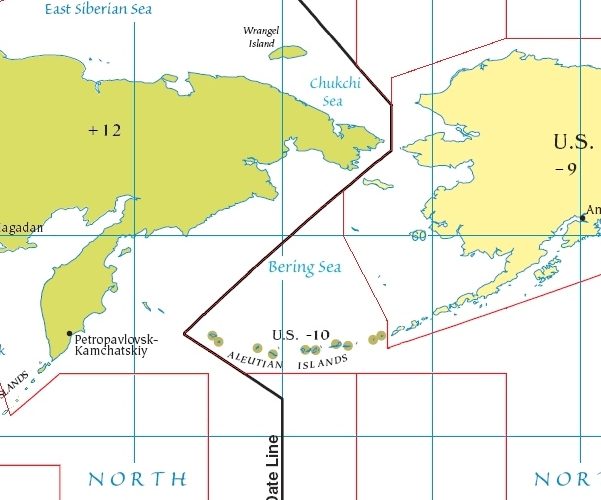
This is where the difficulty arises. Without a dateline, a person traveling eastward around the globe would experience local time advancing as he traveled. If he completed the journey in 24 hours, he would return to his starting point with the clock showing the same local time as when he left, but he would be experiencing the following day. Therefore, there must be a boundary at which the calendar date is adjusted. In the civil calendar, this boundary runs mainly through the Pacific Ocean, with some adjustments to accommodate national borders. The halachic question is whether the Torah has its own such boundary and, if so, where it lies.
This is not simply a question of when Shabbos begins. The time Shabbos begins varies from place to place, even within Eretz Yisrael. Here, the question is different: Which day-night cycle constitutes Shabbos? The answer could shift the date of every Yom Tov by an entire day in some locales.
One of the central sources in this discussion appears in Maseches Rosh Hashana (20b). R’ Ze’ira presents two principles about Kiddush haChodesh. The first is, “The night and day must both belong to the new month.” He then states, “If the Molad occurs before Chatzos (midday), it is certain that the new moon will be visible shortly before sunset.” R’ Ashi explains that this calculation serves l’Akchushei Sahadei – that is, to contradict the witnesses by determining whether their testimony that they saw the new moon is astronomically possible given the calculated time of the Molad.
The Molad marks the beginning of a new lunar cycle. It does not mean that the new crescent moon is already visible; that occurs only later. However, the difficulty relevant to our discussion is not astronomical. What is the connection between R’ Ze’ira’s principles? If the Molad occurs before Chatzos, part of that day has already passed before the Molad. How, then, can the entire night and day be considered part of the new month?
The Ba’al haMaor explains this by considering how the day is counted worldwide. The entire night and day in Yerushalayim need not occur after the Molad. Rather, somewhere in the world, the entire night and day of the date assigned to Rosh Chodesh must fall after the Molad. Chatzos in Yerushalayim is the latest time that the Molad can occur for this to be true.
To understand this calculation, we must distinguish between local time and the date or day of the week. According to the Ba’al haMaor, the “eastern edge” lies six hours, or ninety degrees, east of Eretz Yisrael. In terms of local time, when it is Chatzos in Yerushalayim, evening has already arrived at the eastern edge.[1] But in terms of the calendar date, that location is eighteen hours behind Yerushalayim; a day that began in Yerushalayim the previous evening begins there only now.
We can illustrate this with an example. Suppose it is Chatzos on Shabbos in Yerushalayim. At a point six hours to the east, the sun is setting. According to this calculation, however, Shabbos is not ending there; it is just beginning. The Shabbos that began eighteen hours earlier in Yerushalayim is only now beginning there. Being six hours ahead and being eighteen hours behind are the same on the clock, but they differ by exactly one day on the calendar.
We can now understand the Gemara. If the Molad occurs on Shabbos before Chatzos in Yerushalayim, then by the time Shabbos begins at the eastern edge, the Molad has already occurred. There, an entire night and day will fall within the new month. If, however, the Molad occurs after Chatzos, then even at the last place where that Shabbos begins, Shabbos will already have begun before the Molad. There will no longer be anywhere in the world where the entire night and day of that date fall within the new month.
The requirement that “the night and day must both belong to the new month” is therefore the primary principle. The rule that “if the Molad occurs before Chatzos” provides the calculation for determining whether that requirement can be met. The Ba’al haMaor thus links the two statements: “the two statements express the same principle.” He also interprets the Gemara’s discussion of sighting the new moon within a day that extends across the world, rather than assuming everything stated refers exclusively to sightings in Yerushalayim.
A full discussion of the calculations concerning the visibility of the new moon is beyond the scope of this essay. For our purposes, the key point is the conclusion: Chatzos in Yerushalayim can serve as a decisive boundary only if the day begins at a fixed location. If the day’s beginning could be pushed ever further east, there would always be somewhere in the world where the day had not yet begun. The Ba’al haMaor’s interpretation therefore presupposes a boundary for counting the days that is ninety degrees east of Eretz Yisrael. This was the starting point for the subsequent debate over the halachic dateline.
From the Talmudic Discussion to Japan
The Rishonim did not universally accept the Ba’al haMaor’s interpretation. Rabbenu Chananel, Rashi, and Tosfos understood the passage differently. The Ra’avad challenged his interpretation, and the author of Yesod Olam strongly rejected his calculation. In contrast, the Ritva and Ran accepted his explanation. It is important to distinguish between disagreeing over how to interpret the Gemara and disagreeing over the dateline’s location. Rejecting the Ba’al haMaor’s interpretation does not necessarily mean proposing a different dateline.
The Chazon Ish regarded the writings of the Ba’al haMaor (and the Kuzari) as the basis for establishing the halachic dateline ninety degrees east of Yerushalayim. He added a novel principle: The line cannot divide a contiguous landmass into two separate systems for counting the days. Where the ninety-degree line crosses land, the part of the landmass east of the line follows the rest of it, effectively moving the boundary to the eastern coast. This is known as the principle of Geriras haYabasha, whereby land is drawn along with the main landmass. Separate islands lying east of the line do not, by virtue of this principle, become part of the Asian continent.
This is where Japan became crucial to the debate. The Japanese islands lie east of the line and are not part of Asia’s contiguous landmass. According to the Chazon Ish, the halachic day there is one day behind the locally observed calendar. What Japan calls Shabbos is still Friday by halachic reckoning, and halachic Shabbos falls on the local Sunday. Similarly, Yom Kippur falls on the day after the date indicated by the local calendar.
R’ Yechiel Michel Tukachinsky disagreed. In his Sefer haYomam b’Kadur haAretz, he placed the dateline on the opposite side of the globe from Yerushalayim, 180 degrees away. According to this calculation, Japan lies on the side where the local calendar remains unchanged.
Another approach gives weight to the calendar long established in a particular place and to the established customs of Jewish communities. R’ Shmuel Mohlever opposed displacing an established local calendar based on a newly formulated calculation. The Radvaz provides a basis for this approach by proposing that Shabbos is determined for each person according to his location, though the Radvaz does not explicitly rule out a dateline.
For the purpose of our discussion, the Chazon Ish held that Yom Kippur in Japan must be observed one day later than the local calendar indicates. Those who disagreed ruled that the date should remain unchanged. The question is not whether it was appropriate to adopt an additional stringency in observing a Mitzva, but when the Mitzva itself applied.
To be continued…
[1] [Editor’s note: Part I of this essay presents the dispute over the dateline; Part II will address the rulings issued to the refugees and the role of Sakana in the Machlokes haPoskim.]
[2][Editor’s note: For the purposes of Kiddush haChodesh and other halachic calculations, the 24-hour day is always considered to consist of two 12-hour periods, such that sunrise occurs at exactly 6:00 AM, Chatzos is at 12:00 PM, and sunset/nightfall occurs at 6:00 PM.]


 Rabbi Yosef Sprung