 Rabbi Yosef Sprung
Far From Home[1]
Question:
Shalom u’Vracha,
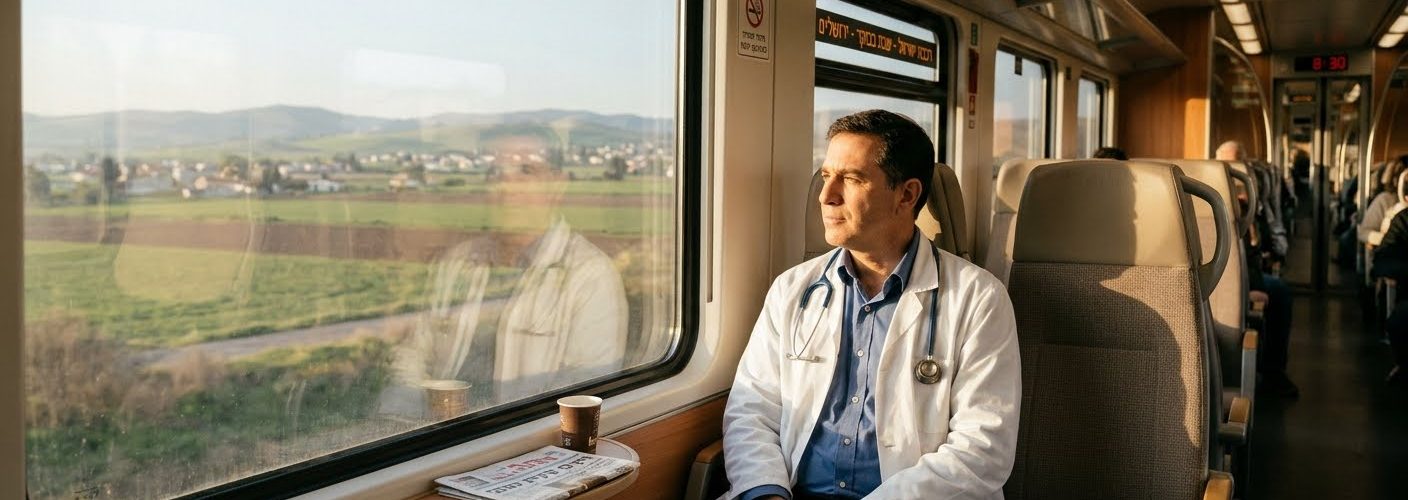
I am a physician at a hospital in Basel, Switzerland, and live with my wife and family in Strasbourg, France. The distance between my workplace and home is approximately 140–150 km. I would like to clarify whether, under pressing circumstances, I would be permitted to travel home by train on Friday night.
During the winter months, Sh’kia is very early, and there are times when I cannot finish my shift at the hospital and get home before Shabbos begins. When Shabbos starts, I am sometimes still at the hospital in Basel, and I can only board the train later in the evening.
Having to remain in Basel on Shabbos regularly creates considerable difficulties for my family. It is very important to me to observe Shabbos in accordance with Halacha, while also being together with my wife and family. I would like to establish whether there is any Halachically permissible way to reconcile my professional responsibilities with my commitment to Shabbos and my family life.
I have already consulted an Orthodox rabbi, who examined the other Halachic concerns of the journey and felt that, under the circumstances I described, they posed no barrier. We also discussed the question of Uvdin d’Chol (weekday-like activity). The train is an ordinary public service operating according to a fixed timetable, and the ticket is purchased in advance. I would not need to make any payments or operate any electrical devices during the journey, nor would I be required to operate the train doors or any of its systems.
The only issue that remains is Techumin (Shabbos travel limits).[2] I studied in Yeshiva for several years, and I am familiar with the main Halachic discussions relevant to this question. I would appreciate it if the Rav could examine the matter and issue a ruling regarding its practical application in my circumstances.
Could several of the following considerations be combined to provide grounds for leniency?
- A continuous chain of settlements. The railway line passes through numerous cities and towns in Alsace, including Mulhouse, Colmar, and Sélestat. Is it possible that, based on the Halachos of Ibur ha’Ir (Halachic extension of a city’s boundary)[3] and Ribua ha’Ir (squaring of a city’s boundary)[4], some of these settlements may be considered contiguous? I am not assuming that such a Halachic continuum exists, but would like to establish whether this is a relevant possibility to investigate and how it should be assessed.
- Techumin above ten Tefachim. In pressing circumstances, is there room to rely on the opinions that apply the principle of Ein Techumin l’Ma’ala m’Asara (there is no prohibition of Techumin above ten Tefachim) to train travel as well? How does the question of whether the train carriage is considered Ara Semichta (solid ground)[5] affect this?
- The twelve-Mil boundary. Can the opinions among the Rishonim who maintain that, even beyond twelve Mil, the prohibition of Techumin is only mid’Rabbanan be taken into consideration?
- Techumin in a Karmelis.[6] Can the opinions that maintain that there is no Isur d’Oraisa of Techumin in a Karmelis be considered (if the areas traversed by the route are indeed classified as such)?
Since on such Fridays I will be at the hospital in Basel when Shabbos begins, I would also appreciate specific guidance regarding the implications of Koneh Shvisa (establishing one’s Shabbos residence)[7] there. In particular, would I be permitted to get off the train in Strasbourg and walk home from the railway station?
Is there a practical Halachic basis for permitting the journey under these circumstances, either by combining the considerations outlined above or through another Halachic argument? If such permission depends on certain conditions or requires changes to the way I travel, I would be grateful to know what they are.
I can provide the precise route, train times, and walking distances, if necessary. I would also appreciate references to the relevant sources.
Thank you very much for your time and assistance in clarifying this question.
With gratitude,
Dr. …
Answer:[8]
Shalom u’Vracha,
Chaza”l permitted rescue personnel who leave their homes on Shabbos to save lives – such as midwives, military personnel, and others – to walk up to 2,000 Amos in every direction from the place where the rescue took place. This was based on the principle of “Hitiru Sofan miShum T’chilasan” (“They permitted their completion for the sake of their beginning”): If they were required to remain at the location until Shabbos ended, they might refrain from going out to save lives in the first place.
The Poskim disagree as to the extent of this leniency. Some maintain that it applies only to the Isurim d’Rabbanan of Techumin; others that it extends to all rabbinic prohibitions; and still others maintain that it may even permit Torah-level prohibitions.[9]
The accepted practice is for doctors and nurses to return home by car driven by a non-Jew. However, when the distance exceeds twelve Mil, R’ Shlomo Zalman Auerbach zt”l maintains that this is not permitted (Minchas Shlomo, Tinyana, 60:18; see also Chazon Ovadia Shabbos 3 pp. 253-254).
Nevertheless, some Poskim maintain that, in pressing circumstances, one may rely on a combination of lenient opinions, including some that you mentioned and several others:[10]
- The opinion that Hitiru Sofan miShum T’chilasan permits even Torah-level prohibitions.
- The opinion that the prohibition of Techumin remains d’Rabbanan even beyond twelve Mil.
- The opinions that a Torah-level prohibition of Techumin applies only in a Torah-level Reshus haRabim, but not in a Karmelis, combined with the opinion that there is no Torah-level Reshus haRabim nowadays.
- The opinions that there is no prohibition of Techumin above ten Tefachim.
- The Ramban’s opinion that there is no prohibition of Techumin when a person is not traveling on foot.
- The Rashbam’s opinion that there is no prohibition of Techumin when a person is not operating the vehicle himself.
To answer your question, we must clarify one further fundamental issue: Does the principle of Hitiru Sofan miShum T’chilasan also apply when the physician is involved in saving the lives of non-Jews?
The consensus among the Poskim is that one must desecrate Shabbos, even by performing Melachos d’Oraisa, to save a non-Jew’s life, because of the concerns of Eiva (enmity) and danger. Nevertheless, a physician should make every effort in advance to avoid working on Shabbos, and should arrange to exchange shifts with a non-Jewish physician, even if this entails financial expense.[11]
Regarding a physician’s return home after treating a non-Jew, the Chasam Sofer rules (Shu”t C.M. 194) that although he is permitted to desecrate Shabbos to save a non-Jew’s life due to Eiva, he may not return home, even if doing so involves only an Isur d’Rabbanan. The reason is that the rationale of Hitiru Sofan miShum T’chilasan does not apply here. There is no concern that the physician will refrain from going out to save lives in the future if he is not permitted to return home, since fear for his own safety will lead him to recognize that failing to go could place him in danger.
The implication of the Chasam Sofer is that when lifesaving activity is permitted because of Eiva, one must establish whether prohibiting the physician from returning home might indeed cause him to refrain from going out to save lives.[12]
In Minchas Asher (2:42), haGaon Rav Asher Weiss Shlit”a discusses whether a physician working in a hospital may return home on Shabbos. He writes that there is considerable room for doubt as to whether he may violate even an Isur d’Rabbanan to return home, for two reasons:
- It is not clear that a physician who was barred from returning home would refuse to work on Shabbos.
- Even if Shabbos-observant physicians were to refrain from working on Shabbos, there would still be sufficient doctors to staff the hospitals, and prohibiting them from returning home would not create any danger.
These doubts are particularly relevant in the case of someone working in a hospital where most patients are non-Jews.
Nevertheless, leading Poskim have already ruled that doctors and nurses may return home in a car driven by a non-Jew. However, this applies only to a hospital in which a significant number of the patients are Jewish.
You did not mention this explicitly, but presumably the vast majority of patients at the hospital in Basel are non-Jews. Therefore, insofar as there is no genuine concern that prohibiting you from returning home would create any danger, it is very difficult to permit the return journey, even if it involves only an Isur d’Rabbanan. This applies all the more to your journey, which far exceeds twelve Mil, beyond which many authorities consider Techumin an Isur d’Oraisa.
[1] This question was submitted to the Beis Hora’ah of the Schlesinger Institute, which receives Sha’alos relating to Refua v’Halacha from around the world.
[2] [Editor’s note: Generally, 2,000 Amos beyond the city or place where one is situated when Shabbos begins.]
[3] [Editor’s note: A city’s boundary is extended to include nearby outlying dwellings, generally those within about 70 Amos of it. The Techum is then measured from this extended boundary.]
[4] [Editor’s note: A city is “squared” by enclosing it in an imaginary rectangle, from whose sides the Techum is measured.]
[5] [Editor’s note: An elevated surface that is Halachically regarded as solid ground, so that Techumin apply even above ten Tefachim (see Eruvin 43a).]
[6] [Editor’s note: A Karmelis, such as an open field or sea, is an area that is neither a Reshus haYachid nor a Reshus haRabim d’Oraisa. Carrying there is prohibited mid’Rabbanan.]
[7] [Editor’s note: The point from which the Techum is measured is based upon one’s location at the onset of Shabbos.]
[8] This response was written by Rav Chananel Heilbron Shlit”a, one of the Institute’s Halachic authorities.
[9] See Igros Moshe O.C. 4:80; Minchas Shlomo 1:8; Shevet haLevi 6:24 & 26; and Chazon Ovadia Shabbos 3, pp. 253–4.
[10] The question of Ribua ha’Ir that you raised is not relevant to our case. Even according to the opinions that two cities whose boundaries overlap are considered one city, it is highly unlikely that there is a continuous chain of settlements along the entire route. For a more detailed discussion of the laws of Ribua ha’Ir and the various types of settlements to which this concept applies, see Nesivos Shabbos by R’ Yaakov Blau, chapter 42.
[11] See Igros Moshe O.C. 4:79 & 5:25; Shemiras Shabbos Kehilchasa 40:17 & 27, and the accompanying notes; and Yabia Omer 8, O.C. 38.
[12] In Minchas Shlomo (1:7), R’ Shlomo Zalman zt”l questions this ruling. From the straightforward reading of the Gemara, it appears that when Chaza”l permitted those who went out to save people from danger to return home, this applied even when the rescuers themselves were also in danger. How then can the Chasam Sofer make this distinction?
I saw the following answer suggested: When it comes to those who go out to rescue others, Chaza”l enacted a general provision allowing them to return home, without distinguishing between cases in which the rescuer himself is in danger and those in which he is not, and regardless of whether there is any concern that he might refrain from going out. However, in the case of a physician treating a non-Jew, Chaza”l made no such enactment. Rather, we are seeking to extend the leniency ourselves, based on the concern that he might otherwise refrain from going out to save lives. Consequently, when there is no such concern, because the physician himself would be placing his life in danger by refusing to go, there is no basis for permitting his return.


 Rabbi Yosef Sprung