 Rabbi Yosef Sprung
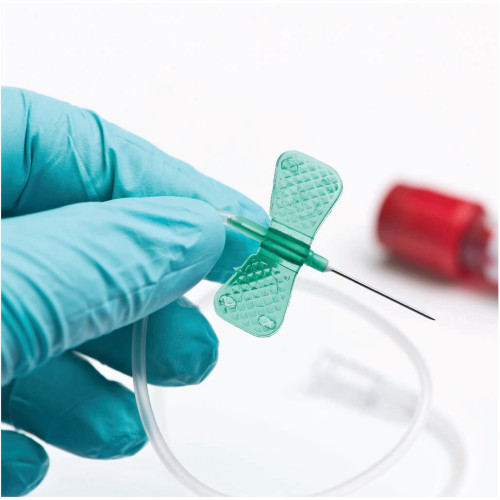
Drawing blood for laboratory tests is one of the most common medical procedures. Usually, after the minimum required amount has been collected, blood often keeps flowing into the vial for a few extra moments – whether for convenience, to guarantee enough blood for analysis, or simply because an extra drop or two doesn’t usually matter.
However, from a halachic standpoint this raises an important question. Once the necessary quantity has been obtained, does the superfluous blood drawn constitute unnecessary injury prohibited by the Torah? Or perhaps it is permissible, since the patient consented to the procedure and is entirely unconcerned with the additional blood.
The Shulchan Aruch rules explicitly (C.M. 420:1):
It is forbidden for a person to strike another. One who does so violates a Lav, as it says: “Lest he continue” (Devarim 25:3). If the Torah was particular regarding the punishment of a wicked person – forbidding additional blows beyond what he deserves – then certainly this applies to striking a righteous person.
Rav Shlomo Zalman Auerbach zt”l asserts that drawing blood unintentionally does not fall under the permission of Davar sheEino Miskaven as that category only applies to matters of Bein Adam laMakom (Nishmas Avraham Mahdura Tinyana 2 p89; Shulchan Shlomo Erchei Refua 1 p213). See also Kovetz Shiurim (2:23:7) and Chazon Ish (O.C. 62:26).
However, the Achronim debate whether a person’s consent allows someone else to inflict bodily harm.
The Chavos Yair (163) discusses this question:
The Mishna states: “One who injures himself, though he is not permitted to do so, is exempt [from payment].” Why should it not be permitted, given that he is effectively waiving his own rights? Nevertheless, the Torah states: “You shall guard your lives carefully.” The Torah was likewise particular about property, as seen in the prohibition of Bal Tashchis. Similarly, [Chaza”l] said, “One who cuts down his plants, though he is not permitted to do so,” etc. The same [is evident] in the entire Sugya of [one who says] “tear my garment,” “break my jug,” or “injure my arm or leg”. [Although the Sugya] pertains to liability and exemption from payment, the act itself remains prohibited, and permission does not help.
In other words, a person’s permission to another to injure him does not eliminate the prohibition.
The Shulchan Aruch haRav expresses a similar concept in Hilchos Nizkei Guf v’Nefesh 4 :
It is forbidden to strike another person even if he grants permission, for a person has no authority over his own body whatsoever – neither to strike it, nor to shame it, nor to cause it any pain, even by withholding a certain food or drink.
The underlying rationale is that a person is not the absolute owner of his body. The body is a Pikadon placed in his care, and he is obligated to safeguard it. Accordingly, he lacks the authority to permit another person to injure him.
The Gemara (Bava Kama 91a) records a Machlokes regarding self-injury. According to R’ Akiva’s opinion in the Mishna (ibid. 90b) it is permitted, whereas a B’raisa quotes him as prohibiting it.
Tosfos (ad loc., s.v. “Ela Hai Tana”) maintain that even for a constructive purpose, a person may not injure himself. They also (s.v. “Over”) comment on the incident recorded in the Gemara in which Shmuel tore thirteen silk garments upon Rav’s death: “A Torah scholar is different, and it was not excessive.”
From Tosfos’ discussion, which addresses the parameters of Bal Tashchis, it appears that injuring one’s own body is likewise prohibited by the Lav of Bal Tashchis.
The Ramah, cited by the Shita Mekubetzes and the Tur (C.M. 420), rules that a person is permitted to injure himself. He adduces proof from the conduct of R’ Chisda , who would lift his garments to avoid damaging them even at the expense of minor bodily injury. Since the Gemara concludes with R’ Chisda’s position, the Halacha follows his view. This position is likewise held by the Piskei Riaz (s.v. “v’I”).
However, the Rambam differs (Hilchos Rotze’ach 11:4). He rules like R’ Elazar haKafar who forbids a person to injure himself, basing this on the Pasuk, “Guard yourself and guard your soul”. (Devarim 4:9) One who leaves dangerous hazards in place thus neglects a Mitzvas Asei and violates the Lav of “Do not place bloodshed [in your house]”. (Devarim 22:8)
He concludes (Halacha 5):
The Chachamim prohibited many things because they comprise a danger to life, and anyone who transgresses them and says, “I am endangering only myself; what concern is that of others?” or “I am not particular about this,’ is subject to Makas Mardus.
The implication is that even in circumstances where Bal Tashchis would not apply, a person is still obligated to protect his body from harm. Accordingly, even under these views, a person cannot grant another permission to injure him.
On the other hand, the Rambam states in Hilchos Chovel uMazik (5:1):
It is forbidden for a person to injure either himself or another. Not only one who causes injury, but anyone who strikes a Jewish person – whether minor or adult, man or woman – in a quarrelsome or aggressive manner violates a Lo Sa’ase, as it says: “He shall not continue to strike him.” (Devarim 25:3) If the Torah warned against striking a sinner excessively, even more so regarding one who strikes a righteous person.
The Shu”t Maharalbach (Kuntres haSemicha 1) infers from the Rambam that the prohibition applies only if the strike is “in a quarrelsome or aggressive manner.” Accordingly, if a person consents to being injured, the act would be permitted.
A similar position is expressed by the Minchas Chinuch (Parshas Mishpatim, Mitzva 48:2):
It appears to me that the Torah imposed liability for striking one’s father, mother, or fellow specifically when done without permission. But if one’s father or mother instructs him to strike or curse them, or if one’s fellow grants permission, he does not violate this prohibition and incurs neither lashes nor capital punishment.
The Gemara in Sanhedrin (84b) relates that certain Amora’im would not allow their sons to remove a splinter out of concern that they might draw blood beyond what was necessary. Some Achronim infer that it is forbidden to injure another person even with his consent – for surely, had permission been effective, they could have granted it.
The Minchas Chinuch addresses this difficulty:
The concern there is that they might unintentionally cause an unnecessary injury. But if the father explicitly waives his honor and instructs him to strike him, it appears that there is no liability at all. The same would apply regarding another person: there is no prohibition whatsoever. Although I have not found this stated explicitly, it is a logical conclusion.”
According to the Minchas Chinuch, we can distinguish between a case in which a person gives explicit authorization for the injury itself and a case in which no such permission was granted.
However, this explanation is not easily reconciled with the Gemara, because the father who refused to let his son treat him out of concern for unnecessary bleeding could surely have stated explicitly that he waived his objection.
Based on the Minchas Chinuch’s reasoning, even if injury is allowed with consent, this approval applies only to the specific act that was consented to. In such cases, when the person explicitly authorizes and instructs the other to perform the act, the consent is unequivocal. In contrast, in the context of medical treatment, there is generally no explicit waiver of unnecessary injury; on the contrary, most patients desire that treatments be performed without superfluous blood loss. Accordingly, this would not constitute a full waiver, even if stated verbally. This interpretation is admittedly somewhat strained, but it seems to best explain the position of the Minchas Chinuch and those who follow his approach.
According to the Rambam, however (following the explanation of the Maharalbach that the prohibition applies only to injury performed in a hostile or aggressive manner), there may be no need for such distinctions at all.
All Poskim agree that there is no prohibition when the injury is performed for legitimate (medical) purposes. However, once the act exceeds what is medically necessary, it would be an Isur d’Oraisa.
However, the Sefer Kovetz He’aros makes an interesting observation (70:1):
At the beginning of Perek haNechnakin (Sanhedrin 84b), Mar brei d’Ravina would not allow his son to lance his blister, lest he cause an injury and inadvertently violate a prohibition. The Gemara asks that the same concern should apply to others and answers that another person would only involve an inadvertent violation of a regular prohibition, whereas, with one’s father, it could involve an inadvertent capital prohibition. At first glance, since the intent is therapeutic, there should be no prohibition of injury at all. It must therefore be that the concern is lest he injure him more than necessary. The Ramban makes a similar case in Toras haAdam, Sha’ar haSakana: “Since another person is available, we do not allow the son to do this, lest he injure him more than is medically appropriate.” It appears that, where no alternative exists, it is even permitted for the son to do it. The same is implied by the Rambam (Hilchos Mamrim 5:7).
According to Rav Elchanan, when a procedure is performed for therapeutic purposes, and more injury is caused than is medically necessary, the concern is only Rabbinic and does not constitute an Isur Torah. Accordingly, when the patient gives his consent, there is an additional basis for leniency.
This point is highly significant for phlebotomy. The act of venipuncture and drawing blood is unquestionably permitted for medical purposes. In many cases, it even constitutes a Mitzva when necessary for diagnosis, treatment, or the maintenance of good health. However, the permission granted for medical treatment is not a blanket license for injury; rather, it is a narrowly defined allowance limited to medical needs. One could therefore argue that once the required quantity of blood has been obtained, there is no justification to continue. From that moment, any further extraction reverts to the status of unnecessary injury, since the entire basis to permit harm is that the injury is secondary to the therapeutic purpose. Once there is no need for additional blood, the act no longer qualifies as “medical treatment,” but as needless bodily harm.
Nevertheless, one could distinguish between the cases discussed by the Poskim and a routine blood test. The Poskim discuss treatment that consists of a specific act (e.g., removing a splinter) after which additional bleeding occurs incidentally and serves no therapeutic purpose. In contrast, when the act itself is the extraction of blood, drawing slightly more than the minimum required may still be considered part of the therapeutic procedure rather than an independent act of injury. In such a case, the patient is almost certainly unconcerned about a few additional drops of blood and would presumably consent explicitly if asked. Moreover, there is often a legitimate practical benefit to collecting slightly more than the absolute minimum. It may prevent the need for a repeat blood test if the original sample proves insufficient, and it can allow for additional testing should the need arise.
Therefore, it seems appropriate to distinguish between two different situations:
When the additional amount of blood drawn is insignificant and could be considered the usual practice – such that any reasonable person would consent to it in advance as an inherent part of the procedure – there is strong support for the claim that it does not constitute “unnecessary injury” at all, even according to the opinions that maintain consent does not permit bodily harm. This is how the act itself is defined. Similarly, when a person consents to surgery, we do not ask whether explicit consent was granted for each additional millimeter of incision beyond the minimum necessary, because the entire procedure is understood as a single medical act carried out within accepted practice norms.
In contrast, where blood is drawn beyond what is routinely obtained, or in quantities lacking any reasonable medical or practical justification, it becomes much harder to permit because the patient “does not mind.” Ultimately, the medical allowance exists only for the sake of treatment and not as a general license to harm another, particularly according to those authorities who maintain that a person’s consent cannot authorize bodily injury at all.
It should also be noted that even where no full Isur Torah is involved, medical personnel nevertheless bear a clear Halachic and ethical obligation to minimize harm to the patient’s body as much as possible. This principle is emphasized throughout halachic literature. The permission granted to a physician to inflict injury is not an expression of ownership over the human body, but a limited authorization granted solely for healing. Consequently, both the spirit of Halacha and professional medical ethics require that any intervention be carried out as precisely and minimally as possible.
In the next essay, we will examine the views of the Poskim on this question in a range of practical scenarios.


 Rabbi Yosef Sprung